
Hand breaded meaning is simple on paper, yet menus use the phrase so loosely that it's hard to know what you're actually getting. You see it on chicken tenders, fried chicken, and pork cutlets, and you wonder whether it signals real kitchen work or just good marketing. This guide explains what the term covers, how it differs from machine breading and batter, and when it's worth paying for.
What hand breaded means
Hand breaded means a person, not a machine, coats the food in its breading. A cook dredges each piece by hand, usually in flour, then egg, then breadcrumbs or a seasoned crumb mix. People searching for the hand breaded meaning are usually trying to figure out whether the label signals real kitchen work or just good marketing.
You will see the phrase on restaurant menus, fast-casual signs, and frozen food packaging. It most often describes hand breaded chicken, tenders, fish, and onion rings. The term has no single legal definition for restaurants, so what it covers can vary by brand.
How hand breading works
Hand breading is a three-stage dredging process a cook does at a station, piece by piece. The standard breading procedure uses flour, then eggs, then breadcrumbs, and it is the core of the hand breaded meaning in most kitchens.
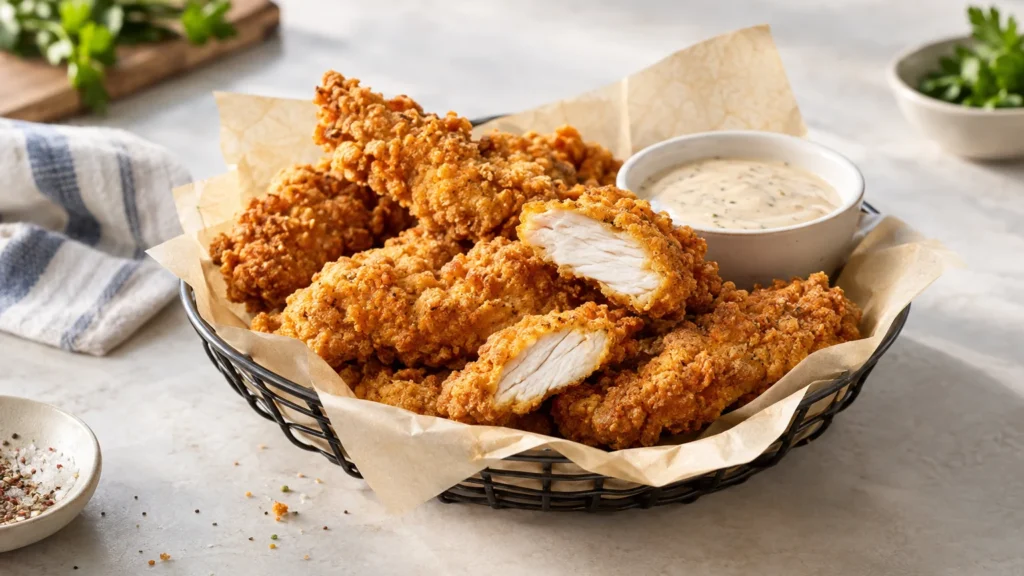
- Dredge in flour. Coat the dry chicken in seasoned flour and shake off the excess.
- Dip in egg. Move it through beaten eggs (often thinned with a little milk or water) so the surface is fully wet.
- Press into breadcrumbs. Cover every side with crumbs and press firmly so they stick.
- Rest, then cook. Let the coating set briefly, then fry or bake until done.
For a full walkthrough of the technique, see this guide to hand breaded chicken.
Hand breaded vs machine breaded vs battered
The three coatings look alike on a menu, but they differ in how they are applied and how they eat. Hand breading is a dry-wet-dry process done by a person. Machine breading runs the same steps on a conveyor line. Battering dips food in a wet mixture and skips the dry crumb layer.
| Method | Texture | Appearance | Consistency | Typical use |
|---|---|---|---|---|
| Hand breaded | Craggy, crunchy, often thicker | Uneven, with ridges and clumps | Varies piece to piece | Restaurant kitchens, made to order |
| Machine breaded | Uniform, lighter crunch | Even, tidy coating | Very consistent | Frozen and mass-produced foods |
| Battered | Puffy, smooth, or crisp shell | Smooth, golden, sometimes bubbly | Depends on the batter | Fish, onion rings, corn dogs |
Does hand breaded mean better quality?
Not automatically. The label describes how the coating went on, not how good the food tastes. Marketing claims vary from one restaurant or brand to the next, so treat it as a clue rather than a promise.
Here is what the term can and cannot tell you:
- Texture: It often means a craggier, more uneven crust, but it does not guarantee crunch.
- Freshness: It does not prove the chicken was never frozen or was breaded that day.
- Ingredients: It says nothing about seasoning, oil quality or additives.
- Safety: It is not a USDA grade, so it does not signal inspection level or quality rating.
If a menu makes specific claims, ask the staff what they mean.
Common hand breaded foods
Restaurants hand bread foods that hold a crisp coating well. Here are the most common examples:
- Chicken tenders: Strips of chicken go through flour, egg and breadcrumbs. This is the item most menus advertise as hand breaded.
- Fried chicken: Bone-in pieces often get a seasoned flour dredge, sometimes with an egg or buttermilk dip first.
- Onion rings: Sliced onions get coated one ring at a time, so the crust clings.
- Pork cutlets: Pounded thin, then breaded and pan-fried, as in a schnitzel or a breaded pork tenderloin sandwich.
- Fish: Fillets such as cod or catfish take a light coating of flour, egg and crumbs or cornmeal.
Want to try the chicken version yourself? This guide to hand breaded chicken covers what makes the crust crisp.
How to spot hand breaded food when ordering
Start with the menu wording, then check the food itself. No single clue proves it, but a few together tell you a lot.
- Menu language: phrases like “hand breaded in-house,” “breaded to order,” or “made fresh daily” point to real kitchen work.
- Irregular coating: craggy edges, uneven thickness, and a few bare spots suggest a person did it. Perfectly uniform pieces often come from a machine.
- Wait time: breaded-to-order food usually takes longer than a freezer-to-fryer item.
- Texture: a thick, shaggy crust that clings to the meat is a good sign.
When in doubt, ask the server: “Is the chicken breaded here in the kitchen, or does it arrive pre-breaded?” A knowledgeable server will usually answer easily. If you want to see what the process looks like, our guide to hand breaded chicken shows the finished result.
Hand breading at home
You can get a crisp, well-stuck coating in your own kitchen with a simple three-step setup: flour, egg, then breadcrumbs. For a fuller walkthrough, see this guide to hand breaded chicken.
- Pat the chicken dry. Surface moisture makes coating slide off.
- Season every layer. Add salt and pepper to the flour, not just the meat.
- Keep one hand dry. Use one hand for flour and breadcrumbs, the other for the egg. You’ll avoid thick, clumpy “club fingers.”
- Press the crumbs on firmly. Then let the pieces rest for 10 minutes so the coating sets.
- Don’t crowd the pan. Crowding drops the oil temperature and leads to soggy crust.
Cook chicken until it reaches the USDA-recommended safe internal temperature of 165°F, and check it with a thermometer.
Key Takeaways
- Hand breaded means a person coats each piece of food by hand, usually in flour, egg and breadcrumbs, instead of a machine doing it.
- The classic method is a three-step station: dredge in seasoned flour, dip in egg wash, then press into crumbs.
- Breading is dry and crumbly. Batter is wet and puffs up. They give different textures, so the two are not interchangeable.
- Hand breaded does not automatically mean better. It points to a more careful process, but taste depends on the ingredients, the oil and the cook.
- Hand breaded does not guarantee fresh, either. Ask whether the chicken is made in-house and whether it is breaded to order.
- Look for menu wording like “made in-house” or “breaded to order,” and expect a slightly uneven, craggy crust.
- You can hand bread at home with three shallow dishes, a dry hand and a wet hand, and a short rest before frying. If you have allergies, always confirm the ingredients with the restaurant.
Frequently Asked Questions About hand breaded meaning
What does hand breaded mean on a menu?
It means kitchen staff coat each piece of food with breading by hand rather than using a factory machine. The coating is usually flour, egg and breadcrumbs. Menus use the phrase to signal more care and a craggier, home-style crust, though the exact process varies by restaurant.
Is hand breaded the same as battered?
No. Breading is a dry coating, often built in layers of flour, egg and crumbs, that fries up crunchy and crumbly. Batter is a wet mixture of flour and liquid that the food is dipped in, and it fries up puffier and smoother. The two methods give very different textures.
Is hand breaded chicken healthier than regular breaded chicken?
Not necessarily. Hand breading describes how the coating is applied, not its nutrition. Calories and fat depend on the portion size, the type of coating, the oil and how the chicken is cooked. For exact numbers, check the restaurant’s nutrition information or ask your server.
Does hand breaded mean made fresh?
Not always. Hand breaded tells you who applied the coating, not when. A kitchen might bread chicken by hand in the morning and hold it, or buy pieces that were breaded by hand elsewhere and frozen. If freshness matters, ask whether the chicken is breaded in-house to order.
What is the difference between hand breaded and hand battered?
Hand breaded food gets a dry coating, usually flour, egg wash and crumbs, pressed on piece by piece. Hand battered food is dipped into a wet batter, often made with flour and a liquid like water, milk or beer. Breading tends to be crunchier and battering puffier.
Why is hand breaded chicken more expensive?
Hand breading takes more labor than machine coating. A cook has to dredge, dip and press each piece, then keep the station clean and fry in batches. Fresh ingredients and higher-quality chicken can add to the cost too. Prices vary by restaurant and location.
Are hand breaded foods safe for people with allergies?
Not automatically. Breading often contains wheat and egg, and shared stations, flour bins and fryers can cause cross-contact with other allergens such as milk or soy. Tell your server about your allergy, ask how the item is prepared, and confirm ingredients with the restaurant before you order.
What is the standard breading procedure?
The standard breading procedure has three steps. First, dredge the food in seasoned flour and shake off the excess. Second, dip it in egg wash. Third, press it into breadcrumbs until it is fully coated. Then fry or bake the food. Resting it briefly before cooking helps the coating stick.
References & Further Reading
- USDA Food Safety and Inspection Service – U.S. Department of Agriculture
- FoodSafety.gov – U.S. Department of Health and Human Services
- U.S. Food and Drug Administration – FDA
About This Article
This guide was written with AI assistance from publicly available information. Prices, nutrition values and availability can change, so confirm important details with the official source before you decide.